
John G. Stephenson
Walk through any tactical equipment display or team staging area today and one thing is clear: Modern SWAT operators have more options than ever – better armor, lighter helmets and improved communications.
Thermal devices, night vision, drones, robots, rifles, optics, breaching tools, medical gear, less-lethal options, tactical vehicles, and a growing list of specialty equipment all promise to make teams safer and more capable.
Most of it can be valuable. The problem is that every new piece of gear comes with a cost. It adds weight, takes up space, requires batteries, maintenance, training, and storage, and may demand new policies or more range and scenario-based training. Before long, a team can find itself carrying more equipment than it can realistically use, support or deploy effectively.
The answer is not to avoid new technology. It is to make sure every piece of equipment earns its place.
More Gear Is Not Always More Capability
Tactical teams are focused on officer safety, mission success and preparing for the worst day their agency may face. That can lead to a simple assumption: More equipment must mean more readiness. Sometimes, it does; often, it does not.
The same holds true for technology. A team may own drones, robots, thermal devices, remote cameras, and advanced communications systems, but that equipment has little value if only one person knows how to use it, batteries are dead, policies are unclear, or the team has not trained with it under realistic conditions.
Capability is not measured by the amount of gear a team owns. It is measured by how well that gear supports the mission.
Start with the Mission
Before purchasing the next piece of equipment, teams should ask a basic question: What problem are we trying to solve?
A full-time metropolitan SWAT team may need a different equipment mix than a regional team serving several counties. A team which regularly handles barricades, warrant service, high-risk arrests, and major public events may have different priorities than one responding mainly to rural incidents, corrections emergencies, active threats, or search and rescue calls.
The mission drives equipment.
Teams should review the incidents they actually handle, not just the ones they might someday face. After-action reports; callout trends; training records; and input from operators, medics, negotiators, snipers, bomb technicians, and command staff can reveal where the real gaps are.
Sometimes the answer is not another piece of gear. It may be better organization, more training time, stronger maintenance support, or a simpler way to deploy equipment the team already owns.
Build a Core Loadout, Then Add Mission-specific Gear
One practical way to avoid overload is to separate what every operator needs from what is mission-specific.
The core loadout should include equipment required for the team’s most common assignments: appropriate body armor, helmet, communications, eye protection, lighting, medical supplies, and other essentials determined by agency policy and mission needs.
Beyond that, teams can rely on mission-specific packages. This approach keeps the basic load manageable while allowing the team to scale up when needed.
The Human Body Still Sets the Limit
Technology changes quickly; the human body does not. Armor, helmets, rifles, communications equipment, medical gear, breaching tools, water, batteries, and other equipment all add up. Even small additions can become a problem over a long operation, especially in heat, cold, darkness, or multi-hour barricades.
A good tactical loadout must account for mobility, endurance and fit. Operators need to move, climb, kneel, work around vehicles, enter structures, communicate, render aid, and stay alert under stress. Equipment which shifts, binds, overheats the operator, or makes it difficult to sit in a vehicle can quickly become more of a burden than an advantage.
Fit matters just as much as weight. Armor, helmets, uniforms, and load-bearing equipment should work for the people wearing them, not just look good on a product display. When gear creates pressure points, restricts movement or causes fatigue, operators may start adjusting it, loosening it or leaving it behind.
Technology Needs a Home and a Plan
Modern tactical technology can be a major force multiplier, but it can also create clutter fast. Cables must be routed safely; batteries need to be charged and tracked; and equipment needs protection from weather, impact and loss.
The more technology a team carries, the more important simplicity becomes. Equipment should make the operator’s job easier, not create another problem to manage. If a device requires constant adjustment; blocks access to essential gear; adds confusion to radio traffic; or demands more attention than it provides in value, the team should reconsider how it is being used.
Technology also needs ownership. Someone should be responsible for batteries, charging, software updates, replacement parts, maintenance, and training records. When that responsibility is vague, equipment tends to become unreliable at the worst possible time.
Communications Cannot Be an Afterthought
A tactical team can have excellent equipment, experienced operators and a solid plan, but poor communications can still derail the operation.
Headsets, radios, hearing protection, push-to-talk systems, interagency channels, and command post information flow all deserve careful attention. Teams need to know who is communicating on which channel; how information moves from drone operators or observers to the team leader; and how emergency traffic will be handled.
The goal is not more radio traffic, but better radio traffic. Clear, disciplined communications reduce confusion, prevent repeated commands and keep the team aligned during fast changing events.
As with all equipment, you need to train with communications systems, not merely be issued it.
Medical Gear Must Be Accessible
A large medical kit stored somewhere in a vehicle is helpful, but it may not be enough during a rapidly developing incident. At the same time, loading every operator down with a full trauma bag can make movement more difficult.
The best approach is usually layered. Operators should have immediate access to the most critical medical gear required by policy and training. Additional supplies can be carried by tactical medics, designated team members or organized in vehicle-based kits.
The team should know who carries what, where additional supplies are located and how casualty care fits into the larger tactical plan. Medical planning should begin before the operation, not after someone is injured.
Keep Team Gear Off the Operator When Possible
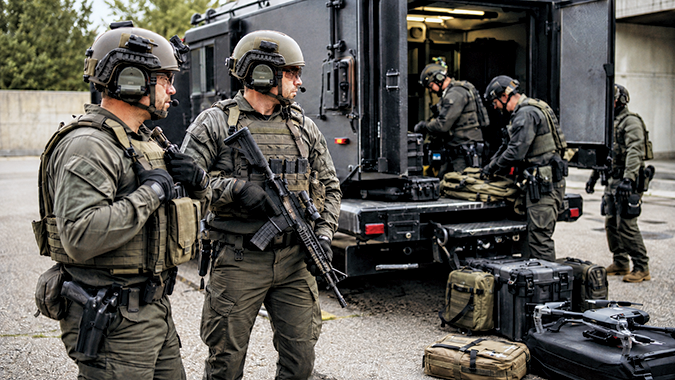
Not everything has to be carried on the body. Ballistic shields, breaching tools, large medical kits, extra ammunition, cameras, drones, robots, less-lethal systems, rescue equipment, water, and cold weather gear may be better carried in a vehicle, equipment cart, mission bag, or designated team kit until needed.
Organization makes the difference. Teams should be able to identify, load and deploy mission-specific equipment quickly. Cases, bags, vehicle storage systems, and color coded kits can reduce confusion during callouts.
A patrol vehicle, armored rescue vehicle or tactical van should support the mission, not become a black hole where gear disappears.
Train for the Gear You Carry
Every new capability creates a training requirement. Teams should avoid buying equipment faster than they can train with it.
The best tactical teams test equipment in darkness, bad weather, cluttered structures, long operations, vehicle deployments, and stressful scenarios. They evaluate what works; what fails; and what becomes awkward once gloves, armor, radios, and time pressure are added.
A piece of equipment which cannot be deployed confidently under stress is not yet a true capability.
Standardization Reduces Problems
Tactical teams do not need every operator configured exactly the same way, but they benefit from standardization.
Common equipment layouts, similar communications setups, consistent medical gear locations, familiar vehicle storage systems, and repeatable mission kits reduce confusion. Operators can move between roles more easily; supervisors know what capability is available; and training, maintenance and replacement become simpler. The goal is not to eliminate personal preference. It is to keep personal preference from becoming operational chaos.
Build Smart, Not Heavy
The best teams build around mission, fit, training, communications, organization, and common sense. They carry what they need, stage what they may need and avoid confusing equipment volume with true readiness.
A well-equipped team is not the team with the most gear. It is the team whose people can move, communicate, think, train, and act effectively when the mission gets difficult.
That is the real goal: not simply more equipment, but better capability.