
Stephenie Slahor, Ph.D.
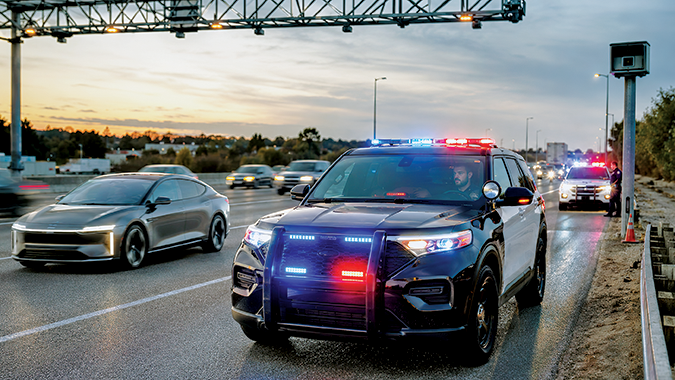
New technology, smarter strategies and practical solutions are reshaping traffic enforcement and roadway safety.
Although traffic fatalities have declined from their pandemic-era peak, tens of thousands of people continue to die on America’s streets, roads and highways each year. The National Highway Traffic Safety Administration estimates that 36,640 people died in motor vehicle traffic crashes in 2025, a 6.7 percent decrease from 2024. The US Department of Transportation continues to seek comprehensive and effective approaches to reducing traffic deaths, including safer vehicles, safer speeds and road conditions, improved driver behavior, and higher standards of post-crash care. With law enforcement playing a key role in preventing and reducing traffic-related fatalities, injuries and property damage, both public education and upholding safety laws come to the fore. Among the recent measures focusing on this are combating impaired and distracted driving, speeding, and determining solutions to safety challenges in a jurisdiction’s streets and highways. These measures also include the law enforcement collected data which identifies and deters unsafe conditions. That information leads to media campaigns; countermeasures to deter unsafe driving; testing programs for laboratory and technical improvements; and initiatives to reduce high-risk situations.
Grappling with Safe Pursuits
When something is bothersome and interferes with sleep, it might be the moment in time when a new and unique solution occurs. Such was the case for Leonard Stock who had seen a disturbing traffic accident account in the news. His creativity was jogged and he developed the idea of the “Grappler,” a device which could avoid the dangers associated with pit maneuvers and spike strips and, instead, bring a fleeing vehicle and driver to a slower and safer stop.
The risks are not merely theoretical. In August 2026, an Arkansas State Police pursuit provided a dramatic example of how quickly a PIT maneuver can produce unintended consequences. During a pursuit on Interstate 555 near Trumann, a fleeing Hyundai Sonata had reportedly reached approximately 130 mph when a trooper performed a Tactical Vehicle Intervention, Arkansas’ term for a PIT maneuver. The Hyundai lost control and struck an uninvolved Toyota SUV occupied by a 68-year-old woman and a 73-year-old man. Their SUV left the highway and overturned several times, leaving both occupants seriously injured and requiring emergency extrication and hospitalization. You can watch the dash cam video on YouTube: Arkansas State Police pursuit ends in rollover crash involving an uninvolved vehicle (https://tinyurl.com/yrcvcx65).
The incident illustrates one of the inherent risks of PIT maneuvers: Deliberately causing a fleeing vehicle to lose directional control can produce unpredictable consequences, particularly at high speeds or when other motorists are nearby. It is precisely this type of risk which Leonard Stock sought to address.
His invention, the Grappler , activates with an in-vehicle switch which releases a heavy-duty nylon net from an assembly mounted on the front of the pursuing vehicle. The net is designed to entangle a rear tire or other rotating component of the fleeing vehicle, while a tether allows the pursuing officer to help slow and bring the vehicle to a controlled stop. Unlike a PIT maneuver, the Grappler does not rely on intentionally striking the fleeing vehicle and causing it to spin. When successfully deployed, it can bring a pursuit to an end within seconds. Among the agencies which have added the Grappler system to their fleets is the Riverside County (CA) Sheriff’s Office (RSO). Lt. Jason Santistevan reports that Grappler systems are installed on the K-9 Unit’s Chevrolet Tahoe patrol vehicles. Additional Grappler systems are scheduled to be installed on select K-9 Unit Chevrolet Silverado patrol vehicles.
At present, only the Sheriff’s K-9 Unit is authorized to operate vehicles equipped with the Grappler system and this is intentional, not only because their vehicles are the right strength and size, but also because the RSO K-9 handlers receive extensive, specialized training in multiple law enforcement disciplines. Among these are high-risk vehicle stops, pursuits, tactical operations, and critical incident response situations. Assigning the Grappler system only to the K-9 Unit ensures it is deployed by personnel with the training, experience and judgment necessary to use the device safely and effectively. This promotes consistent oversight, accountability and operational control of the Grappler program while maximizing the system’s effectiveness in the field, says Lt. Santistevan.
The Grappler Certification Course itself is an eight hour training program consisting of both classroom instruction and practical application. Participants receive instruction on the capabilities, limitations, deployment considerations, safety protocols, and operational use of the Grappler. Each participant must successfully complete both portions of the course and then demonstrate proficiency in the safe and effective deploying of the Grappler system. Only then is the person authorized to operate a vehicle equipped with the Grappler.
The Grappler’s manufacturer does not establish a single minimum or maximum deployment speed applicable to every situation. According to Lt. Santistevan, Riverside County deputies are instructed not to deploy the Grappler at speeds below five mph or above 70 mph. “As with any vehicle intervention technique, deputies shall continually evaluate the totality of the circumstances including vehicle speed, roadway conditions, traffic volume, weather, and public safety” when determining whether deployment of the Grappler is appropriate.
As a onetime use item, after the Grappler has been deployed, a new net must be installed, but can be done so within about five minutes. Reloading a new service net is a simplified process so that the Grappler system can be quickly returned to operational status.
After deployment, the used service net is returned to the Grappler manufacturer and a credit can be issued toward the future purchases of replacement service nets. That exchange program helps reduce replacement costs while ensuring that the Grappler system remains ready for continued field operations, notes Lt. Santistevan.
A Grappler system is only approved for installation on specific vehicle makes and models which are approved by Grappler. A comprehensive list of vehicles which are compatible with the Grappler system can be obtained from the manufacturer at policebumper.com
The Riverside County Sheriff’s Office is planning to add ten more Grappler systems to its K-9 fleet to bring the total in use to 20.
“Nobody’s At the Wheel!”
Fully driverless vehicles continue to provoke debate about their safety and effectiveness. While it might appear that vehicles operating without a human driver would pose greater hazards, Governors Highway Safety Association (GHSA) Chief Executive Officer Jonathan Adkins recently responded to an Insurance Institute for Highway Safety (IIHS) study which found that Waymo’s driverless vehicles were involved in 68 percent fewer police-reportable crashes per vehicle mile traveled than human-driven vehicles in the same cities. Adkins states, “Progress, not perfection, must be the standard for AVs, just as it has been for seat belts, airbags, automatic emergency braking, and every other safety technology that eventually earned the public’s trust.” The new research by IIHS indicates why these technologies should be judged by consistent data over millions of miles, but not by overreactions to a single video or incident not supported by data. Waymo’s AVs crashed far less often than the people driving around them, Adkins noted, adding, “Safety officials must have the tools and information they need to monitor performance, identify emerging safety issues and respond effectively.”
The GHSA and Waymo have partnered to develop virtual, self-paced training to help first responders learn how to interact safely with Waymo’s driverless vehicles. The training consists of three modules which take approximately 30 minutes or less to complete (https://tinyurl.com/mwucb4bx).
Impaired Driving
The GHSA, Responsibility.org and the National Alliance to Stop Impaired Driving (NASID), a coalition established and led by Responsibility.org, have partnered to support efforts addressing alcohol, cannabis and polysubstance impaired driving. One-year grants of $40,000 each were awarded to Kansas, Oregon and Pennsylvania to improve their ability to identify impaired drivers and remove them from the road through enhanced toxicology testing, mobile breath-testing tools and specialized officer training.
The Kansas Department of Transportation has partnered with the Sedgwick County Regional Forensic Science Center to expand the laboratory’s ability to detect the full range of drugs which appear in impaired driving cases. Toxicology scientists will train in advanced mass spectrometry technology to support faster and comprehensive substance identification and accurate detection of polysubstance use referrals for screening and assessment.
In Oregon, the Department of Transportation has partnered with the Oregon State Police to enhance the scope of a high visibility enforcement unit with mobile evidentiary breath testing instruments. These instruments will allow law enforcement to collect roadside breath samples and will reduce investigation time to improve identification of polysubstance impaired drivers.
In Pennsylvania, the State Highway Safety Office and the Center for Forensic Science Research and Education will address the problem that more than a third of all DUI arrests now involve multiple drugs rather than alcohol alone. Complex toxicology data will be transferred into practical, field-ready guidance resources to give access to the most current information.
Are You a Distracted Driver?
Distracted driving poses dangers to self, other drivers and pedestrians, but might an officer also be distracted? Technology in the patrol car, texting, calling coworkers, or looking at information on the MDC can each cause distracted driving.
Recognizing this problem is the US Department of Justice-supported VALOR Officer Safety and Wellness Program (valorforblue.org). VALOR stands for Preventing Violence Against Law Enforcement Officers and Ensuring Officer Resilience and Survivability. The program focuses on a wide range of officer safety and wellness issues, including tactical safety, resilience, decision-making and vehicle safety. Among the less obvious risks addressed is distracted driving. Officers, like other motorists, can become distracted behind the wheel and those distractions can contribute to crashes, injuries, fatalities, property damage, and “close calls.”
Staying safe, attentive and focused on driving is the goal. Chat messages need to be audited regularly. Technology might be needed to stop the in-vehicle computer at a certain speed. Policy must be set to enforce adherence to staying attentive. With most agencies, technology is regarded as a keen addition to officer and vehicle capability, but, often, that same technology keeps adding more gadgets, screens and distractions which can cause an officer to lose focus on the road and driving attentively. And, there may be a problem with having a ride-along, or worse, that prisoner in the back who might also be a “distraction.” Visual and cognitive distractions just might require stopping and pulling over to read or acknowledge a message, rather than doing so while driving.
So, Field Training Officers might want to consider – or reconsider – what might be necessary for better officer safety. Ask about those “near misses” and “close calls” which were caused by distractions like an officer using the phone while driving. Officers must lead by example and be standard bearers against inattentive or distracted driving.
“Commentary driving” is a tool some agencies have borrowed from Europe. It involves talking about everything you see as you drive. That can point out problems in attention – or lack thereof. And, now, there is technology which can focus on a driver’s eyes to see where they are looking and announce what needs to be done to “come back” to attentive driving. The National Law Enforcement Roadway Safety Program and VALOR offer similar safety and wellness concerns with no cost training, technical assistance and resources to prevent officer injuries and fatalities from officer-involved collisions and “struck-by” incidents. Log on to policinginstitute.org for courses ranging from mid- and executive-level officers, patrol officers and “train the trainer” resources and skills. The courses are self-paced in commentary driving, managing distractions, peer-to-peer accountability, mitigating struck-by incidents, and vehicle pursuits. The website’s program catalog details the courses available.
And It’s Not Just on Roadways
Public safety might bring to mind patrols, roadside signage, media reports, and traffic officer training, but another often overlooked “traffic control” is that involving waterways. While many agencies have personnel or volunteers who can assist with specific enforcement on lakes and rivers, there is also a “road” component in some situations in which traffic law enforcement may need to take a role.
One example is preventing unauthorized access to areas where water hazards exist, including those short-term events when a roadway has standing or flowing water impeding safe usage of the road. Turn Around Don’t Drown® signage and large, lighted barriers might prevent most unauthorized access, but some drivers want to dare the water or believe their vehicle will be able to go around or through standing or moving water.
Public education efforts are needed to remind drivers that even relatively shallow moving water can be dangerous. According to the National Weather Service, six inches of fast-moving water can knock an adult off his or her feet, while approximately 12 inches can carry away a small car. Eighteen to 24 inches of fast-moving water can carry away many larger SUVs, vans and trucks. Drivers should never attempt to determine the depth or strength of floodwater by driving through it. Drownings can occur, along with property damage and the additional hazards involved in recovering stranded or swept-away vehicles.
Monitoring conditions during heavy rains and flash floods must be done to patrol and block potentially dangerous areas. Plans must be in place for quick deploying of assistance to victims and also to secure the area to prevent further problems in both roadways and waterways. Coordination with local media keeps the public informed of closures and potential problems.
The Road Ahead
As traffic enforcement continues to evolve, new technology alone will not determine success. The most effective approaches will combine useful tools, accurate data, sound policy, proper training, and good judgment to improve safety for officers and the public alike.
Stephenie Slahor, Ph.D., J.D., is a writer in the fields of law enforcement and security. She can be reached at drss12@msn.com.
Free Traffic Safety Resources for Law Enforcement
National Law Enforcement Roadway Safety Program
The National Policing Institute offers no cost training and a downloadable resource toolkit designed to reduce officer injuries and fatalities on the road. Resources address distracted driving, vehicle pursuits, commentary driving, struck-by incidents, emergency vehicle technology, peer accountability, and agency policy development.
Resource: National Policing Institute – National Law Enforcement Roadway Safety Program
2025 MADD Impaired Driving Toolkit
Impaired Driving Toolkit: A Law Enforcement Leader’s Guide to Saving Lives provides practical information on high visibility enforcement, impaired driving task forces, ARIDE and DRE training, impaired driving investigations and reports, search warrants, prosecution, community engagement, and funding resources.
Download: MADD Impaired Driving Toolkit
IACP Distracted Driving Toolkit
Designed for police executives, supervisors and patrol officers, the IACP toolkit addresses distracted driving education and enforcement, as well as distraction inside patrol vehicles. Downloadable materials include promising practices, talking points, a press release template, resource lists, and officer safety posters.
Resource: IACP Distracted Driving Toolkit
New $20 Million for Traffic Enforcement Innovation
In August 2026, the NHTSA announced $20 million for its new Innovative Traffic Safety Enforcement (ITSE) Grant Program to develop, test and validate new approaches to impaired and distracted driving, speeding, reckless driving, and seat belt enforcement. Potential projects can include new safety technologies, predictive and data-driven analytics, specialized training, and other scalable enforcement strategies. The NHTSA anticipates making up to ten awards, with individual awards starting at approximately $300,000. No matching funds are required and applications are due September 1, 2027.
Program information and application: Grants.gov – Funding Opportunity NHTSA-693JJ926R000024-FY26
All Traffic Solutions Offers Foldable InstAlert Message Sign
All Traffic Solutions’ InstAlert is a portable variable message sign designed for law enforcement, traffic management and public safety applications. According to the company, InstAlert is the only foldable variable message sign currently on the market.
The sign folds in half for transport and can be carried in the trunk of a patrol vehicle. It can be deployed on a portable post, vehicle hitch, mobile trailer, or pole, providing agencies with a flexible way to communicate traffic guidance, roadway incident information, special event notices, and other public safety messages.
InstAlert can be remotely managed and monitored through a secure online portal using a computer, smartphone or tablet. Messages can be scheduled in advance for specific dates and times. A tamper detection feature can also capture a photo and send a real-time alert if the sign is disturbed.
The full-matrix LED display supports multiple rotating screens with customized text and graphics. The unit is designed for all-weather use and is manufactured in the United States.A video demonstrating InstAlert is available on YouTube at https://youtu.be/kvCjYMahmR0