
Melissa Krum Dooher
For more than two decades, acoustic gunshot detection has helped law enforcement respond faster to gunfire, but its value increasingly extends beyond the initial alert and into the investigation itself.
Properly utilized, acoustic gunshot detection can provide investigators and prosecutors with essential forensic evidence of when a shooting occurred; where it occurred; and, in some cases, how it unfolded.
As gunshot detection technology becomes more common in criminal investigations, courts and practitioners must understand the legal principles governing its admissibility. The legal analysis varies depending on whether the evidence consists of audio recordings and business records or expert forensic analysis.
Gunshot Detection Technology Overview
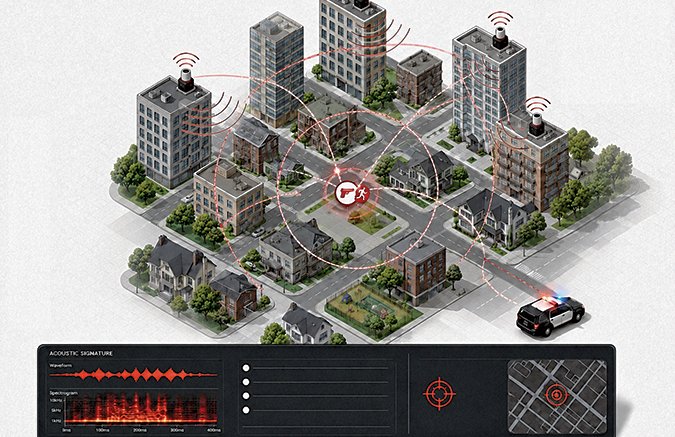
Gunshot detection systems operate through a network of acoustic sensors positioned throughout a coverage area. When gunfire occurs, multiple sensors capture the sound and transmit recordings and timing data to a central processing system.
The most advanced systems determine the location of gunfire using the same basic scientific principle seismologists use to locate earthquake epicenters. Using a process known as multilateration, the system compares the slight differences in the time the impulsive sounds reach each sensor to estimate where the sounds originated.
Proprietary algorithms serve as an initial screening mechanism, filtering out sounds inconsistent with gunfire. Potential events are then reviewed by trained human analysts who make the final determination on whether to issue a gunfire alert – a process used by systems such as ShotSpotter®. Once confirmed, gunfire alerts are transmitted to law enforcement in near real time, typically within 30-60 seconds of the shooting.
Part I: When the Audio and General Timeline Are Enough
In many criminal cases, the investigative value of acoustic gunshot detection is relatively straightforward. There, investigators and prosecutors simply want to establish that gunfire occurred at a particular time and place, or they want the judge or jury to hear the recorded gunfire because the number and cadence of the shots is relevant to intent and premeditation.
The recordings can establish a timeline, corroborate witness testimony or physical evidence, and help understand the sequence of events.
A recent homicide prosecution in St. Louis County illustrates the point. In a domestic violence incident, the defendant confronted his former girlfriend outside her mother’s home. The mother intervened in the heated argument. The defendant pulled out his gun and fired 16 rounds, striking both women multiple times, killing his former girlfriend.
The recorded gunfire revealed three distinct volleys separated by pauses of up to two seconds – details which could not have been fully appreciated from witness testimony alone. Prosecutors relied on the audio to argue that the breaks between volleys provided the defendant with time to reflect before resuming fire, supporting a finding of deliberation and premeditation. The jury returned a first-degree murder conviction.
From an evidentiary perspective, cases seeking to admit audio recordings generally involve traditional authentication principles. The technology provider should be able to provide the audio recordings along with an affidavit verifying that they were recorded and maintained in the ordinary course of business.
At SoundThinking (the company where I oversee the team of ShotSpotter forensic experts), we have seen courts routinely admit recorded gunfire once a proper foundation has been established. The relevant principles are similar to those which govern the admission of surveillance video, body-worn camera footage, and automated license plate reader data.
In the St. Louis example, the audio recording was admitted into evidence using a certified business record. But, if needed in other cases, a custodian of records can testify to authenticity and explain the general operation of the gunshot detection system. When gunshot detection technology is used primarily for the value of the audio recording, the focus is not on complex scientific analysis, but on establishing the reliability of the recording process and the integrity of the evidence.
Used in this manner, acoustic gunshot detection evidence rarely presents controversy akin to novel scientific methods.
Part II: When Forensic Analysis Becomes Critical
Some shootings, however, are far more complicated.
Investigations may involve multiple shooters, competing claims of self-defense, or conflicting evidence about who fired first. In these cases, acoustic gunshot detection data can provide insights well beyond timeline, shot count and cadence.
In advanced gunshot detection systems, forensic analysis can help determine whether multiple firearms were used; distinguish gunshots from echoes; identify shots not automatically classified by software; and clarify the sequence of fire. This analysis is performed by forensic experts – including in-house specialists at the technology provider – who examine waveforms, spectrograms, timing data, and other acoustic characteristics to evaluate the evidence.
A case I charged in Oakland a few years ago illustrates the value of forensic analysis in cases involving competing self-defense claims.
Two men exchanged gunfire from their vehicles while positioned driver-side to driver-side, resulting in the death of an innocent passenger. Both defendants claimed self-defense, so the timing of shots became a critical issue at trial. Forensic analysis of the recordings showed that gunfire from two firearms was simultaneous, supporting the prosecution’s theory that the defendants were engaged in mutual combat. The jury convicted both defendants of homicide.
Unlike the mere authentication of audio recordings, forensic analysis can place the reliability of the underlying scientific methods at issue.
By example, federal courts and numerous state courts have subjected (ShotSpotter) recorded gunfire evidence to Daubert scrutiny and determined that the underlying science is well-established and the technology reliable. The Daubert test is flexible and focuses on overall reliability rather than rigid criteria.
A smaller number of jurisdictions continue to apply the older Frye standard which asks whether the scientific methodology has achieved general acceptance within the relevant scientific community. State courts in California, Illinois, New York, and Pennsylvania have concluded that this technology is generally accepted and thus admissible in court.
When forensic conclusions are central to the issues in dispute, courts may examine the underlying science and methodology through Daubert or Frye hearings. Gunshot detection technology providers should have expert witnesses to explain the relevant scientific principles and the methodologies employed during forensic analysis. Agencies which have access to qualified forensic experts through their technology provider are generally better positioned to address these evidentiary challenges.
Targeting Violence, Not Communities
Despite its proven investigative and evidentiary value, acoustic gunshot detection technology faces criticism from some advocacy groups and commentators who allege its deployment is discriminatory because it is often concentrated in nonaffluent urban neighborhoods.
That argument confuses the location of the technology with the location of the violence. Shootings are disproportionately concentrated in a relatively small number of communities. Deploying lifesaving technology where gun violence is most prevalent is not discrimination – it is a targeted, data-driven response to a documented public safety problem.
Residents of violence plagued neighborhoods deserve the same access to public safety resources and rapid emergency response as any other citizens.
Conclusion
As its use becomes more widespread, acoustic gunshot detection is increasingly serving not only as a rapid response tool, but also as a reliable source of evidence in criminal investigations. Understanding both its investigative and legal dimensions is essential for effective use in the field and the courtroom.
Melissa Krum Dooher retired from the Alameda County District Attorney’s Office in Oakland, California, after 25 years of service as an Assistant District Attorney. She now serves as the Senior Director of Forensics & Litigation Support at SoundThinking, where she manages the team of forensic experts who produce the ShotSpotter forensic reports and testify in court. For ShotSpotter-related forensics questions, contact the team at forensics@soundthinking.com