
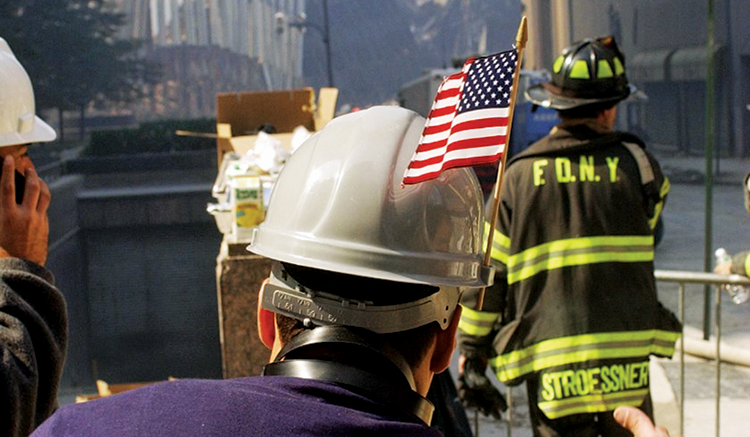
On September 11, 2001, an ordinary Tuesday morning changed America forever. Today, the images remain difficult to comprehend: smoke pouring from the World Trade Center; the Pentagon burning; a scarred field near Shanksville, Pennsylvania; firefighters climbing stairways as civilians descended; and police officers directing people away from danger while others moved toward it.
The terrorist attacks claimed 2,977 lives at the World Trade Center, the Pentagon and aboard Flight 93. For America’s public safety community, September 11 also demonstrated what the oath to protect others can require.
Law Enforcement’s Sacrifice
Police officers were among the first to respond to the World Trade Center and among those who paid the highest price. The FBI recorded 72 law enforcement officers killed as a result of the attacks. Twenty-three were members of the New York City Police Department. Another 37 were members of the Port Authority Police Department – the largest loss of personnel by a single American police force in one event.
Yet, statistics tell only part of the story.
Officers evacuated buildings, cleared streets, helped the injured, and tried to establish order as conditions changed by the minute. Some had been dispatched. Others simply saw what was happening and responded.
FBI Special Agent Leonard W. Hatton was traveling to work when he saw smoke and fire coming from the North Tower. He went directly to the World Trade Center and joined FDNY firefighters evacuating people. He was still inside when the towers collapsed. His actions were extraordinary, but the instinct behind them was repeated throughout that morning.
A Public Safety Loss without Precedent
Nearly 1,000 FDNY firefighters deployed to the World Trade Center and 343 died that day. Firefighters, EMS personnel, police officers, communications personnel, medical personnel, and others responded in New York, at the Pentagon and near Shanksville.
Many remained long after the cameras were gone. Rescue became recovery. Personnel searched debris, collected evidence, recovered remains, and assisted victims’ families.
For law enforcement, an enormous investigative responsibility was also beginning. The FBI launched PENTTBOM, the largest investigation in Bureau history. More than 4,000 special agents and 3,000 professional employees participated, pursuing more than half a million leads and conducting more than 167,000 interviews.
The Toll Did Not End in 2001
The National Law Enforcement Officers Memorial Fund recognizes 535 additional law enforcement officers who later died from illnesses associated with their 9/11 response. Together with the original 72, the number of officers honored for 9/11-related deaths stands at 607.
The FDNY has likewise reported more than 400 members lost to World Trade Center-related illnesses since the attacks. The federal World Trade Center Health Program now serves nearly 150,000 responders and survivors nationwide.
How 9/11 Changed Policing
September 11 reshaped American law enforcement. The attacks underscored the need for stronger communication and intelligence sharing among local, state and federal agencies. Counterterrorism became a responsibility extending far beyond Washington and New York.
Today, approximately 200 FBI Joint Terrorism Task Forces operate around the country, while fusion centers provide state and local hubs for sharing threat information. Training, communications, emergency planning, and interagency relationships have evolved. The underlying responsibility has not.
Law enforcement must prepare for dangers not yet visible, recognize warning signs, share information, and respond when prevention fails, while continuing to protect the constitutional rights and freedoms the profession exists to defend.
They Reported for Duty
There is now an entire generation of public safety personnel with no personal memory of September 11. That makes remembrance more important, not less.
Those entering the profession today should understand not only what happened, but what their predecessors did when confronted by it.
They established evacuation routes and perimeters. They carried the injured. They searched rubble. They guarded critical infrastructure. They worked crime scenes of unprecedented size and investigated hundreds of thousands of leads. Many continued serving while carrying illnesses caused by their work at the attack sites.
Some never returned home. Others returned home, but ultimately surrendered their lives years later.
On this 25th anniversary, we remember all 2,977 people murdered on September 11, 2001, and the families who have lived with that loss for a quarter century.
Within the public safety community, we offer particular remembrance to the police officers, federal agents, firefighters, EMS personnel, and emergency workers who answered when their nation needed them.Their legacy lives in every officer who reports for duty and every public safety professional who accepts a simple, but profound, responsibility: When others need help, we go.