
Carl Mazzanti
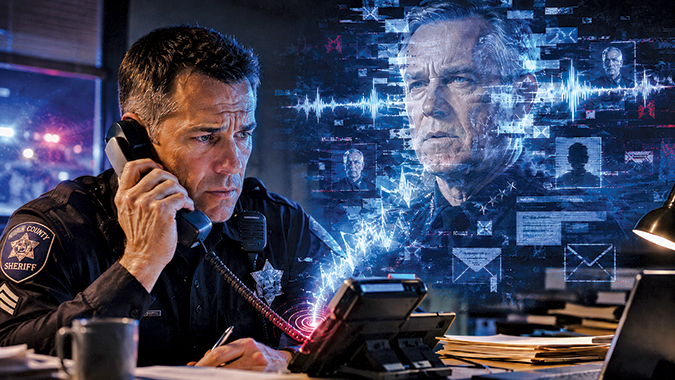
Picture a patrol officer working a late shift when the phone rings. Caller ID appears to show the chief’s direct number. The voice on the other end sounds right; the cadence, inflection and manner of speaking are unmistakable. Then comes an urgent order.
Leave the scene. Provide credentials to an internal system. Transfer funds for a confidential operation. Send sensitive information to another officer immediately. Perhaps even disregard an instruction received minutes earlier.
The officer has every reason to believe the order is legitimate. After all, it sounds exactly like the chief – except it isn’t.
Advances in artificial intelligence have made it increasingly easy to clone a person’s voice or manipulate existing video and audio. For law enforcement agencies, that undermines an assumption which has existed for generations: Hearing a familiar voice is no longer proof that the person speaking is who he or she claims to be. And, the threat is no longer theoretical.
When the Chief Becomes the Impostor
In October 2024, the Salt Lake City Police Department warned residents about an unusually sophisticated impersonation scam involving Chief Mike Brown. A Woods Cross resident received an email from what appeared to be a police-related account. Attached was a video incorporating footage from an interview Brown had given to a television station several years earlier. The accompanying audio had been artificially generated to closely mimic the chief’s voice. The supposed chief told the recipient that a wire transfer had failed and claimed that nearly $100,000 was still owed to the federal government.
At first listen, the recording was convincing. Salt Lake City police said the audio closely impersonated Brown’s voice and could lead someone to believe the message was genuine.
Closer examination exposed the deception. Speech patterns were unnatural, certain words received unusual emphasis, the tone varied, and edits could be detected between sentences. There was another clue: The message came from a Google account incorporating the department’s name rather than an official slc.gov email address.
The case demonstrated how easily television interviews, press conferences, social media videos, and other recordings already in the public domain can provide the raw material for an impersonation attempt. For police executives, it raises an even more troubling question: What happens when the target is not a citizen, but an employee accustomed to acting on orders from that official?
A Familiar Scam Gets More Convincing
Law enforcement impersonation scams are not new. What is changing is the technology available to make them more believable.
In 2024, the Merrimack County Sheriff’s Office in New Hampshire received dozens of reports of scam calls involving people pretending to be law enforcement officers or relatives. Sheriff David Croft said scammers were manipulating voices with artificial intelligence while also spoofing caller ID information so calls appeared to originate from his office. Some victims were told there was a warrant for their arrest and that money, sometimes cryptocurrency, had to be paid to resolve it.
The problem has also expanded well beyond individual police departments. In May 2025, the FBI warned of a malicious messaging campaign in which attackers used text messages and AI-generated voice messages to impersonate senior US officials. Significantly, many of those targeted were themselves current or former senior federal or state government officials or people within their contact networks.
Then, in July 2026, the FBI’s Internet Crime Complaint Center issued another warning. Criminals were creating AI-generated videos depicting a senior FBI leader and using them to encourage victims to submit information through a fraudulent website masquerading as the FBI’s IC3 complaint portal.
The combination is particularly concerning. Artificial intelligence helps establish trust, while familiar government branding, spoofed websites, phone numbers, and email identities reinforce the deception.
From Spoofed Sheriff Calls to AI Kidnappings
Traditional impersonation scams continue to evolve alongside their AI-powered counterparts. In August 2026, Pennsylvania Attorney General Dave Sunday warned of an increase in calls impersonating local county sheriff’s offices. Scammers spoofed telephone numbers so the calls appeared legitimate, then claimed recipients had missed federal grand jury duty or a court hearing and faced arrest unless they paid “bail” or a “bond.”
The problem was evident in York County, Pennsylvania, where the sheriff’s office reported numerous calls from scammers posing as department employees. The callers used the names of real personnel and, in some instances, spoofed the sheriff’s office telephone number.
Victims were told they had an active warrant, had missed jury duty, or had a relative in prison or the hospital. They were then pressured to make an immediate payment to resolve the supposed problem.
A July 2026 incident in Boone County, Missouri, showed how much more convincing the same strategy can become when artificial intelligence is added. A resident received a call displaying the contact name and telephone number of the person’s daughter. A voice sounding like the daughter said she had been kidnapped at gunpoint. Another voice then demanded ransom money.
Authorities later located the daughter safely in Jefferson City, unaware that the call had even occurred. The Boone County Sheriff’s Office said the daughter’s voice had been generated with AI. The technology may change, but the underlying strategy remains remarkably consistent: establish authority or familiarity, manufacture urgency and discourage the target from taking time to verify what is happening.
When a Police Captain Gets the Call
Lorain Police Captain Jacob Morris saw that playbook firsthand. Morris, a 16 year veteran of the Ohio department, received a call from a man identifying himself as “Captain Michael” with the Medina County Sheriff’s Department warrant division.
The caller said Morris had failed to report for jury duty and that a warrant was about to be issued for his arrest. There was, however, supposedly a way to resolve the matter: Pay $2,400.
The scammer had chosen the wrong target. Morris quickly recognized red flags, including the caller’s mispronunciation of Medina and a story that did not fit his understanding of court procedures. Rather than hang up, he began recording the conversation on his personal phone and allowed the caller to continue.
After roughly 20 minutes, Morris revealed that he was a police officer and had recorded the exchange. The recording was subsequently shared to help the public recognize similar scams.
There was no sophisticated AI clone involved in the Morris call. That is precisely what makes the incident useful.
The caller relied on the same elements which make technologically advanced scams effective: authority, fear, urgency, and the assumption that the person on the other end of the line is legitimate. Add a cloned voice, a spoofed agency number or a manipulated video and recognizing the deception becomes considerably more difficult.
The Risk Inside the Agency
For police agencies, the danger extends far beyond fraudulent requests for money. A convincing impersonation of a chief, sheriff, commander, or supervisor could potentially be used to obtain credentials, request sensitive files, authorize financial transactions, or persuade an employee to take an action which would never normally be approved through an informal communication.
That makes impersonation a cybersecurity issue as much as an awareness and training issue. Agencies should begin with one simple principle: No high-risk request should be authenticated solely by a familiar voice, video image, email address, or caller ID.
Verification procedures should be established before an incident occurs. Sensitive or unusual orders may require a callback to a known telephone number, confirmation through a separate communications channel or another predetermined authentication method.
The objective is not to make routine communication cumbersome. It is to ensure that consequential decisions cannot be authorized simply because a phone screen, email address, face, or voice appears familiar.
Building a Layered Technical Defense
Departments should also examine the technical safeguards surrounding their communications and information systems. Email systems should be configured to identify spoofing and impersonation attempts, with properly implemented SPF, DKIM and DMARC protections for agency domains. Advanced email security systems can also flag suspicious sender behavior, unusual links and look-alike domains.
DNS layer security remains valuable for blocking connections to known malicious domains, phishing infrastructure and command and control systems. However, it should be part of a layered defense rather than treated as a complete solution.
Security Information and Event Management, or SIEM, technology can help agencies correlate activity across email, endpoints, servers, identity systems, and other network resources. A Security Operations Center (https://tinyurl.com/3bbb6k6w) can then monitor those alerts and investigate unusual behavior, such as abnormal login attempts, suspicious account activity or access from unexpected locations.
For agencies without the personnel or resources to operate those capabilities internally, a qualified managed service or managed security provider can supply some or all of that monitoring and response capability. Multifactor authentication, preferably phishing-resistant MFA (https://tinyurl.com/4vvwankw) where technically feasible, should also be required for accounts providing access to records systems, dispatch applications, administrative networks, and financial functions. A scammer may be able to clone a chief’s voice. That alone should never be enough to gain access to an agency’s systems.
Build the Policy Before the Call Comes
Technology alone will not solve the problem. Departments need policies which recognize the changing definition of identity in the AI era. Officers and civilian employees should understand that caller ID can be spoofed; email addresses can be imitated; video can be manipulated; and even the unmistakable voice of a trusted supervisor can now be reproduced. High-risk requests deserve verification regardless of who appears to be making them.
Jacob Morris recognized his scam because he understood the warrant process well enough to know that the caller’s story did not make sense. The recipient of the Salt Lake City video had enough doubts to alert police.
Future attempts may provide fewer obvious warning signs. That is the larger lesson. The next impersonator may not mispronounce the name of a county or send a poorly written email. The next request may arrive from what appears to be the right telephone number, accompanied by the right face and delivered in the right voice.
Law enforcement agencies cannot prevent criminals from creating those deceptions. They can, however, make certain that a voice, even the chief’s voice, is never enough by itself to authorize a consequential action.
Carl Mazzanti is president of eMazzanti Technologies (emazzanti.net) in Hoboken, New Jersey, providing IT consulting services for organizations ranging from home offices to multinational corporations, municipalities and police departments.
Free Resources for Fighting AI Impersonation
Law enforcement agencies do not have to build their defenses against AI-enabled impersonation from scratch. Several federal resources are available at no cost and can help agencies recognize synthetic media, strengthen cybersecurity, train personnel, and prepare for impersonation attempts.
FBI Artificial Intelligence/Deepfake Guidance
The FBI identifies warning signs associated with AI-generated audio, images and video, including unnatural pauses, unusual inflections, abnormal phrasing, inconsistent background noise, visual distortions, and unnatural movement. The Bureau also cautions that synthetic media has become sophisticated enough that visual or auditory clues alone should not be relied upon.
Official link: https://tinyurl.com/3834xa88
Easy search: FBI AI deepfake guidance
NSA/FBI/CISA Deepfake Threat Guidance
Contextualizing Deepfake Threats to Organizations addresses synthetic media impersonation, organizational preparedness, authentication procedures, employee training, and responses to deepfake exploitation attempts. The guidance also encourages organizations to rehearse how personnel should respond before an actual incident occurs.
Official link: https://tinyurl.com/y4w7xpm2
Easy search: NSA deepfake threats organizations
FBI Internet Crime Complaint Center (IC3)
A July 2026 FBI warning describes criminals using AI-generated videos of FBI personnel along with fraudulent websites and other impersonation techniques. The advisory provides practical indicators for identifying suspicious videos, messages, URLs, telephone numbers, and contacts, as well as information victims should preserve when reporting an incident.
Official link: https://tinyurl.com/zf3th5mz
Easy search: IC3 PSA260720
CISA Cyber Hygiene Services
CISA provides no cost vulnerability scanning and web application scanning to eligible US federal, state, local, tribal, and territorial government organizations, including qualifying police and sheriff’s agencies. These services can help identify weaknesses which attackers may attempt to exploit during credential stealing or impersonation campaigns.
Official link: https://tinyurl.com/3d6xx6dz
Easy search: CISA Cyber Hygiene
CISA Cyber Security Evaluation Tool (CSET®)
CISA’s free CSET software helps organizations evaluate their IT and operational technology cybersecurity posture. Agencies can use it to identify potential weaknesses involving authentication, network configuration, access controls, and other areas which may become targets during social engineering or impersonation attacks.
Official link: https://tinyurl.com/mr5wvjr3
Easy search: CISA CSET
CISA Tabletop Exercise Packages
CISA provides downloadable tabletop exercise materials covering phishing, ransomware, insider threats, and other cyber incidents. Although there is not a specific “deepfake police chief” exercise, agencies can readily adapt social engineering scenarios for roll call or command training. For example: A lieutenant receives an urgent voice call apparently from the chief ordering credentials released or a financial transaction approved. What happens next?
Official link: https://tinyurl.com/bdhjpp26
Easy search: CISA tabletop exercises
DOJ COPS Office CRI-TAC
The Collaborative Reform Initiative Technical Assistance Center provides no cost, individualized technical assistance to state, local, tribal, and territorial law enforcement agencies. Assistance can include consultation; training; policy development; strategic planning; and resource referrals in areas including technology, intelligence and information sharing, leadership, management, and supervision.
Official link: https://tinyurl.com/2fbf4m42
Easy search: COPS CRI-TAC