
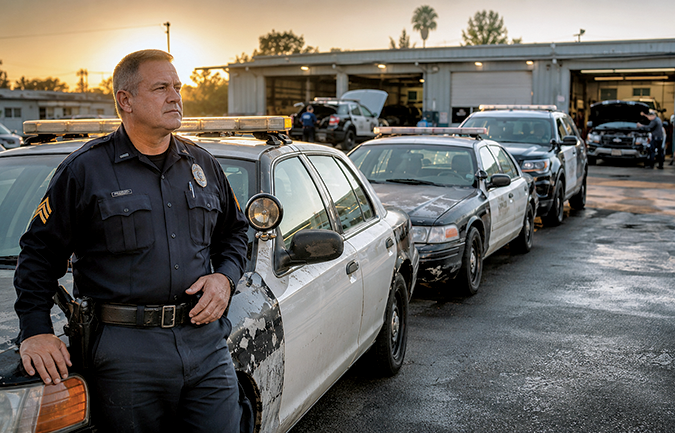
Sergeant James Post
“Where have all the cruisers gone; long time passing?
Gone to junkyards, everyone. Oh, when will they ever learn?”
My appreciation to the late Pete Seeger, as his 1960s war lament seemed perfect to “customize” for this article because we currently have a police car shortage in the land of the free. Sure, there are “new” cruisers which can be seen, sat in and driven at the LE expos, but the most are rebadged earlier models or humongous SUVs and just not what cops want or need.
In the last several years, American automakers have faced a perfect storm of supply chain disruptions, semiconductor shortages, production changes, model discontinuations, rising costs, and an industry-wide shift toward SUVs, trucks and electrified vehicles. Police fleet production has been caught in the middle. New LE units are available, but choices have narrowed and prices have increased at a remarkable rate. Manufacturers also point to the growing amount of safety, communications and electronic technology now built into modern vehicles. Even online auctions for used cruisers have become expensive, as discontinued Crown Vics and Dodge Chargers – still favorites among many cops – continue to command astonishing prices.
Departments with large fleets are increasingly forced to keep vehicles in service well beyond the mileage which once signaled the end of their useful life which can also reduce their eventual trade-in or resale value. As a result, these units may sit out of service for extended periods while awaiting costly replacement parts.
For example, Washington, DC’s Metropolitan Police Department (MPD) has faced serious fleet availability problems. Earlier this year, nearly 200 MPD units were reportedly sidelined for maintenance or repairs. Average daily fleet availability has also declined: 95.5% in 2023, 92.8% in 2024 and 90.9% in 2025. MPD spent approximately $8.47 million in FY 2025 for vehicle parts and repairs – an average of roughly $5,100 per vehicle annually.
As we reported recently, the Illinois State Police (ISP) are also facing a serious replacement problem. More than 1,000 vehicles have reportedly reached, or are approaching, recommended replacement thresholds and ISP officials have warned that, at current funding levels, replacing the agency’s aging fleet could take approximately 18 years. That means many sedans, SUVs and pickups will continue accumulating miles long after agencies traditionally would have replaced them.
While the Arkansas State Police (ASP) still have a fair number of Ford® Police Interceptor® Utility vehicles and Tahoes in-service , some ASP troopers are still driving high mileage 2023 Charger Pursuits until replacements can be purchased. (The popular Chargers were discontinued in 2024.)
This situation is being repeated across the country as production constraints, procurement delays, limited model choices, and rising costs continue to complicate fleet replacement.
Where Can I Find a Cruiser?
Some agencies have filled shortages with used cruisers purchased from area departments and online auctions, and it’s been reported that some departments have even loaned extra units to shorthanded neighboring PDs.
During a shortage, previous one officer units may have to carry two officers and some “take-home” programs may be temporarily reduced or suspended. Major special events can put still more pressure on available fleets. The 2026 FIFA World Cup, for example, required host cities and surrounding jurisdictions to commit large numbers of officers, specialty units and support vehicles for extended periods.
Dare to Be Different
Police departments may also have options beyond traditional fleet purchases, including short-term leases and rentals where state and local procurement rules, insurance requirements and vendor agreements permit them. Because laws and purchasing regulations differ substantially among jurisdictions, fleet managers should have their legal, risk management and procurement personnel review any temporary vehicle arrangement before signing a contract.
If leasing or renting, shorter agreements may provide greater flexibility while permanent fleet shortages are resolved. Agencies should also confirm in advance that the vendor allows law enforcement use, including the installation of emergency equipment and removable graphics.
To avoid return charges or contract violations, agencies should use removable, no drill equipment and temporary vinyl graphics whenever possible. Any agreement should clearly spell out insurance coverage, permitted modifications, maintenance responsibilities, and vehicle return requirements.
When considering temporary vehicles, don’t overlook nontraditional choices, such as SUVs, which are readily available in preferable white or light colors, such as gray or silver. However, agencies should carefully match the vehicle to its intended assignment. Standard civilian vehicles may lack the braking, cooling, handling, tires, and other heavy-duty components found in police package vehicles and may not be appropriate for pursuit or other high-speed emergency operations. If non-pursuit capable vehicles are used for patrol or support duties, their operational limitations should be clearly established by agency policy. Changes in color or body style from the permanent fleet should also be communicated to the public when appropriate.
Covert Assignments
Undercover and surveillance operations open up a variety of rental/lease possibilities not ordinarily considered for patrol. For these assignments, the primary consideration is the ability to blend in. The goal is to use the types of vehicles common to your area. Also, avoid bright colors, expensive sports cars and vehicles which have been customized.
During several years supervising vice and narcotics units, I had good results using ordinary, older vehicles for surveillance assignments. In some jurisdictions, agencies may be able to obtain temporary vehicles through approved agreements with dealers or other legitimate sources. Vehicles should be safe, properly registered and insured, and any arrangement should be documented and authorized under agency policy and applicable state law.
As with rentals and leases, responsibilities for maintenance, repairs, insurance, and permitted use should be agreed upon in writing. Depending on local law and agency policy, unconventional vehicles – such as work vans, tow vehicles, delivery vehicles, and other commonly encountered models – can provide excellent cover because they blend naturally into the community.
Remember, you are only limited by your imagination; however, using an officer’s personally owned vehicle for covert assignments can create unnecessary security, liability and privacy concerns. A vehicle directly connected to an officer may expose identifying information or make it easier for a suspect to associate the vehicle with the officer or the officer’s family. Agency owned or properly authorized covert vehicles are generally the safer choice.
Mustangs
In the past, we discussed the growing popularity of Ford Mustangs for highway patrols. They have reentered duty as interstate enforcers by a number of states, many of which had used the earlier 1982-1993 version, the Fox Body SSP (Special Service Package).
The return of Mustangs to highway enforcement comes as agencies look for alternatives to the traditional high-performance police sedan. The Crown Victoria Police Interceptor® disappeared years ago, while production of the previous generation Dodge Charger Pursuit ended after the 2023 model year. With fewer rear-wheel drive police sedans available, some agencies have turned once again to the Mustang for specialized traffic and highway enforcement.
Although Ford does not currently build a police package Mustang, departments have found that the rear-wheel drive Mustang GT works quite nicely for specialized enforcement. The GT’s standard 5.0L Coyote V8 produces 480 horsepower and available factory performance equipment can include upgraded brakes and exhaust components. Police radios, lighting, graphics, and other LE equipment must be added by the agency or its upfitter. An added benefit is that Mustangs attract attention at community and recruiting events – especially from younger car enthusiasts – and historically maintain strong resale appeal. Saddle up.
Our neighbors to the north are also changing the appearance of their police fleets. The Royal Canadian Mounted Police recently unveiled its first major redesign of frontline vehicle markings in more than 30 years. The new design uses highly reflective black-and-white graphics intended to improve visibility while retaining the familiar RCMP identity. The redesigned vehicles will gradually appear across Canada as the fleet is replaced.
New Graphics for an Old Cruiser
Another way to modernize your fleet while waiting for new cruisers (you can’t find) is to change your graphics. Many American departments are changing graphics now to those which celebrate our 250th anniversary. We’re not suggesting changing the fleet colors by repainting or even “wrapping” them in another color, just updating the graphics.
The Indiana State Police took advantage of adding Mustang GTs and Dodge Durangos to its fleet by introducing a retro-style white over blue appearance inspired by earlier Indiana State Police cruisers. When possible, new graphics can be added to remaining fleet vehicles to present a uniform appearance.
The Arkansas State Police recently took a different approach as their garage repainted one of their 2023 Chargers in a 1960s two-tone paint scheme with current markings. They changed the lighting to a contemporary lightbar, as this beauty is used for enforcement every day, with an occasional appearance at a town parade or festival.
Remember, any graphics or color change should be announced in the media to the public.
New Units and Squads
As part of the Missouri State Highway Patrol’s commitment to supporting the FIFA World Cup activities in Kansas City this summer, specialized troopers and additional resources were assigned to help manage large crowds and address other public safety situations associated with the tournament. State and local agencies devoted substantial personnel and equipment to the event, and officials reported that the Kansas City World Cup celebrations concluded without major public safety problems.
Cop Vehicle News
There are a couple of new vehicles of particular interest to law enforcement fleets you need to check out.
Are you tired of counting all those black Suburbans in DC convoys? Well, never fear, because Ford has announced the 2028 Expedition Police Responder. It comes standard with four-wheel drive, a 3.5L EcoBoost® V6, ten-speed automatic transmission and an electronic locking rear differential with 3.73 gears. Police-specific features include Police Dark Car, Police Engine Idle, Police Perimeter Alert, and a 360 degree camera system. Inside are two rows with seating for five occupants and durable police-duty upholstery.
The Expedition joins Ford’s established LE lineup which includes the Police Interceptor Utility – America’s best-selling police vehicle – and the F-150® Police Responder pickup.
Ram has also announced the 2027 ProMaster City®, a midsize van available in cargo and passenger configurations and a smaller partner to the full-size ProMaster vans already serving as SWAT, CSI, equipment, and prisoner transport vehicles. The ProMaster City uses front-wheel drive and a 1.6L turbocharged four-cylinder engine, with approximately nine feet of available cargo floor length.
New Names for Old Friends
Two familiar public safety vehicle equipment companies have recently undergone significant corporate or branding changes, although their established product lines remain available.
Pro-gard™ Products has been acquired by HAVIS, bringing together two familiar public safety vehicle equipment companies and expanding HAVIS’ portfolio of integrated law enforcement vehicle solutions.
Tenhold™, formerly Jotto Desk and now a Kiefer Sage sub-brand, continues to supply law enforcement vehicle equipment and mounting systems. The company has also introduced a new Suppressor Lock Head for its Weapon Mounting System, designed to secure weapons equipped with suppressors. Tenhold says its equipment is currently used by agencies in more than 25 states.
Sergeant James Post has 27 years of experience in a variety of assignments in the Kansas City, MO, Police Department, as well as other police and fire agencies and the US Marshals. He can be reached at kopkars@arkansas.net.