
By Michael T. Rayburn
What Supervisors Should Reinforce Before, During and After Commercial Vehicle Stops
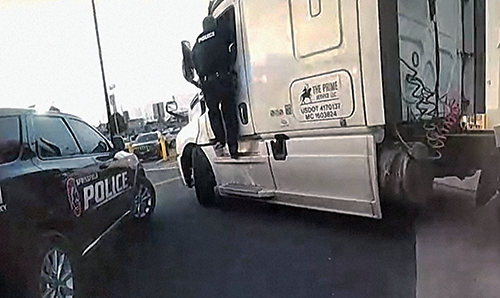
Law enforcement has seen too many recent examples of officers grabbing onto moving vehicles, reaching into driver compartments or physically attaching themselves to vehicles to keep someone from driving away. The intent may be understandable. The result can be catastrophic.
That risk increases sharply when the vehicle is a tractor-trailer (a recent example can be viewed at https://tinyurl.com/2n73vzpw).
No officer can physically stop a 30,000 pound commercial motor vehicle with body weight, strength, urgency, or determination. Whether the vehicle is a sedan, pickup, box truck, or big rig, grabbing on, jumping on or placing yourself in the path of movement is a losing tactic.
Supervisors and trainers should say this plainly: Disengaging from a moving vehicle is not weakness. It is sound tactics. It preserves life, reduces agency exposure and keeps officers available to continue the investigation safely.
There is also a legal and administrative concern. When officers place themselves in danger through actions which did not need to occur, they create risk for themselves, the public and the agency. This is often discussed as officer-created jeopardy or officer-induced jeopardy. The issue is whether the officer’s actions escalated the encounter. That concern can surface in civil claims, workers’ compensation reviews, internal investigations, and insurance matters. The better answer is planning, positioning, communication, and discipline.
Initial Considerations
The initial steps for stopping a tractor-trailer are similar to any other motor vehicle stop. The officer must be able to articulate the legal reason for the stop; know the location and direction of travel; assess roadway and traffic conditions; and advise dispatch of the intended stop, vehicle description, direction, and any risk factors.
The differences begin with size, weight, stopping distance, blind spots, and terrain. A tractor-trailer cannot safely stop or reposition like a passenger car. The driver may need additional time and distance to find a safe place to stop, whether that is a shoulder, ramp, rest area, or parking lot large enough to accommodate the rig and keep everyone clear of traffic.
This is where supervisory messaging matters. Officers should be trained to think ahead before activating emergency equipment. Where will this stop occur? Is the shoulder paved and stable? Is traffic heavy? Is there an off-ramp, weigh station, rest area, truck stop, or large parking lot nearby? A few extra seconds of planning can prevent a dangerous roadside contact.
Choosing the Stop Location
The stop location is one of the most important tactical decisions in any commercial vehicle encounter. Whenever possible, look for a flat, paved, stable surface. A soft shoulder can create problems quickly. A tractor-trailer may sink into dirt, gravel, mud, or grass. In worse conditions, the vehicle may become stuck, lean or create a rollover risk. That can quickly become a traffic, safety and liability issue.
Officers assigned to highway details often wait until the vehicle reaches a safer location, such as a rest area, off-ramp, weigh station, or wide paved shoulder. That is usually the better choice when circumstances allow.
If the initial stop occurs in a poor location, the officer is not locked into that decision. If the driver is cooperative and conditions allow, direct the driver to move to a safer place, such as a well-lit parking lot, an off-ramp lane or a wider shoulder. The first stopping location does not have to be the final one.
Getting the Driver’s Attention
Because of the height, length and blind spots of a tractor-trailer, the driver may not immediately see the patrol vehicle. The officer may need to move where the driver can see the emergency lights, but this must be done with caution.
Avoid driving alongside the tractor-trailer and remaining there. The area next to a big rig is hazardous. The officer may be in a blind spot, exposed to traffic and vulnerable if the driver makes a sudden lane movement.
Once the driver becomes aware of the stop, do not assume noncompliance simply because the vehicle does not pull over immediately. Many commercial drivers understand the limitations of their vehicles and may be avoiding a narrow shoulder, bridge, curve, construction zone, or area with no safe escape path. Officers should remain alert, but evaluate the totality of the circumstances before deciding the driver is fleeing or resisting.
Respect the High Ground
The driver and any passengers in a tractor cab sit above the officer. That creates an immediate tactical disadvantage. The officer is looking up, often from a position where the driver’s hands are difficult to see.
For that reason, standing directly beside the cab door may not be the best option. One safer alternative is to move forward of the cab, where the officer can look through the front windshield and better observe movement inside the cab. A driver could fire through the windshield, but the same threat exists at the door, where the officer may have even less visibility. The goal is to improve visibility, control distance and avoid unnecessary exposure.
If conditions allow, the officer can direct the driver to exit and walk back to a safer contact position. This keeps both out of the traffic lane and gives the officer a chance to evaluate body language, compliance, balance, and demeanor.
Officers who work commercial vehicle enforcement may sometimes be trained to step onto running boards to inspect documents, observe the cab or check a logbook. That practice deserves careful review. The value of seeing a logbook entry or minor contraband does not outweigh the risk of falling, being trapped, being dragged, or losing reaction time at the side of the cab.
Positioning the Patrol Vehicle
There is no single patrol vehicle position which works for every tractor-trailer stop. Roadway design, traffic, shoulder width, lighting, weather, terrain, and the officer’s objective all matter. The primary factor is officer safety. A sound position should provide protection from passing traffic, give the officer a view of the driver and create options if the encounter changes.
The Left Offset Position
In a left offset position, the officer stops behind the tractor-trailer with the patrol vehicle offset slightly to the driver’s side. A distance of about 15 to 25 feet behind the trailer provides a wider field of view and avoids crowding the vehicle. As with cover, crowding limits visibility, movement and reaction time.
From the left offset position, the officer may choose a driver-side approach, passenger-side approach or call-out. If using a passenger-side approach, the officer can move around the rear of the patrol vehicle and approach from the side which best reduces exposure to traffic. Some officers may choose to move between the patrol vehicle and trailer to get to the passenger side. This should be done only when it is safe and necessary. If a position limits visibility, movement or safety, it is the wrong position for that stop.
The Call-out Option
A call-out can be a strong option on tractor-trailer stops, especially when traffic, visibility, cab height, driver behavior, or officer safety concerns make an approach undesirable.
If traffic noise is manageable, use the public address system and direct the driver to exit the cab and walk back to the officer’s location. Tell the driver what to do, where to walk and where to stop. Keep the driver out of traffic and away from areas which expose the officer unnecessarily.
A call-out allows the officer to observe the driver before direct contact. Are the hands visible? Is the driver steady on his/her feet? Is he/she angry, confused, compliant, or looking around for an escape route? These observations help the officer decide how to proceed.
If the PA system is not working (which happens all too often), the driver may still be watching through the side mirrors. Once positioned near the rear of the trailer on the safer side, the officer can use hand gestures to direct the driver back. The officer should not rush into a poor position simply because the first communication method failed.
The Parallel Position
The parallel position places the patrol vehicle directly behind the tractor-trailer, aligned with the curb or shoulder. This may be necessary because of roadway design or limited space. The advantage is simplicity. The officer remains behind the rig and can maintain a view of the vehicle. As with other positions, increased distance can improve visibility.
The disadvantage is that this position does not create much of a protected area for a driver-side approach. For that reason, a passenger-side approach or right-side call-out is often preferable, depending on traffic and shoulder conditions.
The Pull-around Position
The pull-around position can provide a high level of officer safety in the right environment, but it is not appropriate everywhere. After the rig has stopped, the officer pulls around on the left when safe, then parks approximately 45 to 50 feet in front of the rig at an angle, outside traffic. From there, the officer can stand behind the patrol vehicle and call the driver forward or back to a controlled contact position.
The advantage is distance and frontal control. A tractor-trailer is slow to accelerate from a dead stop which gives the officer more time to react and reposition if needed. The patrol vehicle may also provide some cover if the officer comes under fire.
The drawback is traffic visibility. Vehicles approaching from the rear may not see the patrol vehicle or emergency lights until they are alongside the tractor-trailer. That makes this position unsuitable for high traffic roadways, narrow shoulders, curves, hills, and other locations where approaching drivers have limited warning. This tactic depends on preplanning and is best reserved for open areas, rest areas, ramps, parking lots, or locations where traffic exposure is minimized.
Supervisory Priorities
Middle managers shape how officers handle these stops. Policy, training and culture should send the same message.
First, officers should not use their bodies to stop vehicles. This includes grabbing door frames, reaching through windows, standing in front of vehicles, jumping on running boards during movement, or otherwise placing themselves where vehicle movement creates an immediate deadly threat.
Second, officers should be trained to preplan commercial vehicle stops. The safest stop often begins before the emergency lights are activated.
Third, supervisors should review body-worn camera and dash camera footage not only for mistakes, but for teachable moments. Good tactics should be reinforced. Unsafe habits should be corrected early before they become accepted practice.
Finally, commercial vehicle stops should not be treated as rare exceptions. Big rigs are involved in traffic violations, impaired driving, stolen property movement, human trafficking, drug transportation, and other enforcement concerns. Officers should not be intimidated by the size of the vehicle, but they must respect it.
Final Thoughts
A tractor-trailer is not mysterious. In many ways, it is a very large motor vehicle with a professional driver who is required to have a valid license, valid registration documents for the tractor and trailer, and proof of insurance. The stop may begin with a simple violation and develop into something more, just like any other traffic stop.
The difference is consequence. A poor decision around a passenger car can be dangerous. A poor decision around a tractor-trailer can be unforgiving.
The officer’s mindset should be simple: Slow down, think ahead, choose the location carefully, communicate clearly, use distance, and do not create unnecessary jeopardy.
There are heroes in law enforcement. None of them are bulletproof and none of them can stop a big rig by hand.
Michael T. Rayburn has been involved in law enforcement since 1977 and is the author of five books. He is a former Adjunct Instructor for the Smith & Wesson Academy and is the owner of Rayburn Law Enforcement Training. He can be reached at combatgunfighting.com