
Ramesh Nyberg
God Has Already Blessed America
I’m writing this column from the other side of the Earth.
Yes, once again, I’m in India, sweltering in heat and humidity which makes me long for Miami weather, as hard as that is to imagine. Once more, wherever I go in the world, I can’t help but be drawn to the police: What are they wearing? What are they carrying? What are they doing? I’ll start with Bali.
Since we were vacationing in this part of the world, we decided to take a side trip to Bali. It was my first venture south of the equator and what struck me first was the traffic. In the five days we were there, I saw a total of one police vehicle and it was parked. I saw no patrol of any kind; no traffic cops managing intersections. Incredibly, the flow of vehicles (85% of them motorbikes) is intense, constant and unrelenting, yet it’s also extremely orderly. People stay in lanes; they don’t honk; and they wait in patient, single file lines for traffic lights. This contrasts wildly with the city of Kolkata (in West Bengal, India) where I am currently. Here, the traffic is an absolute circus of swerving motorbikes, auto rickshaws, cars, trucks, and pedestrians, all moving with the urgency of a freshly kicked anthill, to the never-ending symphony of beeps and honks. It’s truly astonishing: Everyone misses each other by inches (this is no exaggeration), yet everyone seems completely unbothered, dodging each other and bustling for position – lanes be damned. The skill of drivers here is truly impressive. Besides the organized chaos of Kolkata’s crowded streets, the steering wheels are on the right and you drive on the left side of the road. I would not attempt to drive here unless at gunpoint.
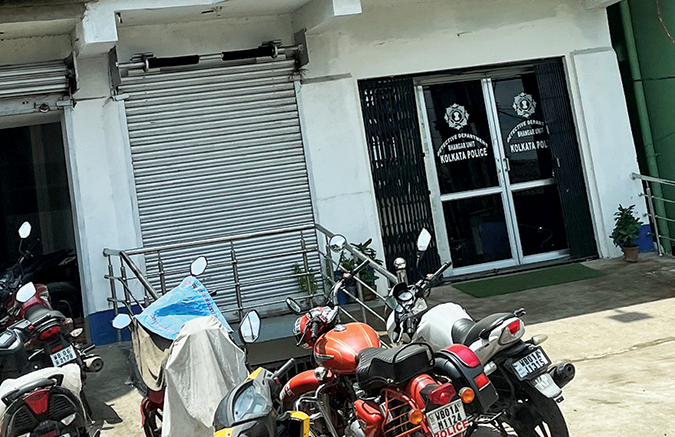
The police here are slightly more visible than in Bali, but, rather than patrolling, they are usually on the way from one point to another on main roads. To see a police car on one of the narrow residential streets is rare. In the six years I have been coming here during the summer, I had seen one accident, and it was minor. That changed the other day.
My wife and I were en route to a shopping mall in an Uber. It was a typical, 15-30 mph, stop-and-go ride, when our driver hit the brakes hard to avoid a swerving motorbike and the guy behind hit us. It was a minor jolt. Our driver looked in the rearview mirror, said nothing and kept going. No one stopped to get out and assess damage; there was no exchange of driver information. Everyone here is far more intent on getting to their destination than they are worried about a small dent in their bumper.
As a former homicide detective, I was curious about the homicide rate here. This is a city of 16 million, about three times the population of Miami-Dade County, where I live, and their per capita homicide rate (homicides per 100,000 residents) is .2 – yes, you read that right, 2/10 of one percent. Miami-Dade has calmed down significantly since my days in homicide, registering a very tame 6.45 rate in 2024. Back in the 1980s (the cocaine cartel days), we led the nation with a staggering rate of 30. But, it’s not fair to compare two such disparate cultures. Nationwide, Kolkata’s homicide rate is the lowest amongst all of the major cities. New Delhi, the capital, has the highest rate with 2.3.
If the victim demographics are anything like most jurisdictions everywhere, the majority of these murders will be domestic related. So, the average person’s potential to be a victim of violence here is pretty much nil. At shopping centers, ATMs and food stalls, I saw why this could be: The people here have infinite patience, far more than we Westerners do. They’ll stand patiently in a long line, or at a traffic light – even while three motorbikes come sneaking up and get right in front of your car – without a word of hostility, anger or without flipping anyone off. I suppose it could be a quiet acceptance that, in a city of 16 million people, you have little choice but to be patient. You’re not going to get the traffic to move faster by getting upset; the honking isn’t done out of anger or impatience – it’s simply a way to say, “Hey, I’m over here on your right.” You would think that the lack of police presence would embolden people to commit more crimes, but the truth, I learned, is that this could be extremely hazardous to one’s health. You see, here, the citizens have taken Sir Robert Peele’s philosophy to heart: The police are the public and the public are the police. If you snatch someone’s chain or purse on a crowded street, there is an excellent likelihood that you will be instantly chased down by a group of citizens and gleefully beaten to a pulp. They might call the police after the pummeling.
The other day, I was waiting for my wife to finish up some shopping and I wandered down the street in search of India’s favorite soft drink, Thums Up®. It’s very much like Coca-Cola®, but with a slightly richer taste. The guy at the stall I went to didn’t have it, but a random dude standing nearby heard me and pointed down the street to another stall. Then, he said, in broken English, “Come, I’ll show you.” He walked me down the crowded block to a vendor who had a nice cold Thums Up (for which I paid the equivalent of eighteen cents). I’m sure there are some nasty folks here, like everywhere else, but for the most part, all I’ve encountered are calm, happy, helpful folks.
I didn’t get a chance to talk to any of the cops here, but I feel for them; their pay is minimal, to the point where the police departments have dorms they can apply to live in for free. There won’t be anything luxurious about the living arrangements, but it might be better than whatever they would have to settle for outside the police housing. Very few cops can afford their own cars here and use either motorbikes, bicycles or public transit to get to work. Like most of the populace, they hang their clothes out to dry on clotheslines. Why? Because dryers take up too much space in typically small apartments, but mostly because electricity is extremely expensive. That lifestyle doesn’t make people here “poor.” No, poor is what I saw at a large, outdoor shopping bazaar, where I saw an entire family living under an expressway, the children barefoot and running around on grimy streets. Poor is seeing those folks get their water from the hand pumps which the city turns on twice a day. I could go on.
If you’re guessing that my message is “be grateful for what we have,” then, yes, that is pretty much the point I am making – not just police-wise, but as a culture in general. I think we could all use some more patience, some more acceptance of things we can’t change. Maybe we could – for a few magic moments – forget what political side we support and, instead, just lend a random person a helping hand, even if it is to go get a Thums Up.
I’ll be back stateside in one week and I’ll enjoy – as I always do – the comforts of home. But, I’ll always remember what the other side of the Earth (indeed, most of the world) deals with on a daily basis. Tomorrow is July 4th, so happy belated Fourth to you all. I would add, “God bless America,” but rest assured, God has already done so.
Ramesh Nyberg retired from law enforcement in November 2006 after 27 years of police work. He lives in Miami and teaches criminal justice at a local high school. He also teaches regional law enforcement courses through Training Force, USA. He enjoys getting feedback from readers and can be reached at ramesh.nyberg@gmail.com. Also, Ram has written a new book, Badge, Tie and Gun: Life and Death Journeys of a Miami Detective, which is available on Amazon in both Kindle eBook and paperback. You can find it by visiting amazon.com/dp/B0CTQQKQTV